This is a long post. It's about me losing my hearing.
Having an operation and receiving a Cochlear Implant, and hearing again.
If you are in the same situation that I was, I hope it helps.
It was originally written on my WP blog. I've tidied it up a little, making it easier to read.
07/11/2018
In November 2018, I went trail running. After a CrossFit WOD that morning
While out, I slipped or tripped and fell over. Feeling a weird pain that went all through my body. I knew straight away that I had probably fractured or broken something in my left ankle.
Later that evening. Direction the local AE for a check-up and an X-ray. As there wasn’t a specialist in the hospital that night. They just strapped my ankle and told me to come back the next day. Sadly and often, that's French hospitals for you.
09/11/2018
Two days later, I saw the specialist at the same hospital, and he, like the doctor before, just strapped my ankle and suggested some blood thinners, as I wouldn’t be able to move the leg correctly for a couple of months. The doctor didn’t see any fracture, just thought I’d badly sprained my ankle. I also had my first shot of blood thinners. (which I would then receive every day for several weeks)
I then went and saw my own doctor, who, after looking at the X-ray (which was of poor quality). He saw that it wasn’t just a sprain but a fractured Maléole / Malleolus in several places, which the hospital hadn’t even seen or suspected. He suggested I get a scanner done. Also suggested swapping out the strapping for a boot that fixed my foot and ankle so that it was protected and supported correctly.
This was Thursday. Later, Thursday night, after another blood thinner injection, I started having some extreme ringing in my ears, especially on the right side. So the next day I rang the hospital to ask if the blood thinners could have any side effects, as there was no other reason for it, and I wasn't taking any medicine except paracetamol. They said that they weren’t / couldn’t answer my question and told me to ring 15 (the emergency service) and ask the same question, which I did.
They informed me that no. No side effects, but told me that Saturday (the next day), there was an ORL (specialist for ears) who would be on standby at my local hospital and that I should go and see her. (For info, all the doctors then and later stated that the blood thinners had nothing to do with my loss of hearing).
All I know is that the moment when I started taking them, the acouphènes / tinnitus /ringing started in my ears, especially the right side, and my hearing died on me in about three days after having the first shot. I don’t believe in coincidences, and I wasn’t taking any other treatments.
10/11/2018
Saturday at the AE. I saw the specialist almost straight away. She realised that my right and left ears had badly degraded as I was already having a hard time understanding her.
For info, both my ears have been in poor shape for over three to five years. Too much loud music. (I was in the music business) And also, I was a pure Walkman generation. Both my ears have had small hearing aids for years now, but this has suddenly become more like being almost deaf rather than just hard of hearing.
The specialist asked me to come back on Monday for an audiogram and more tests. I received no treatment.
12/11/2018
Monday, back to the hospital, again with the same friend, as I couldn’t walk correctly with the leg strapped up. Also, because I could no longer understand what was being said to me. He also had to write everything down that was said to me so that I could understand.
The problem was that in those last three days, my hearing in the right ear had gone from almost normal to totally deaf.
In the right ear, I could hear almost nothing at all; an audiogram showed a loss of 90db, (about 90%) in the right ear
In the left ear, they also found I had lost about 70%. Worse still, it no longer understood any spoken words. I was hearing but not understanding.
They suggested that I have some scans done. So scanner of my ears and at the same time for my ankle.
My local hospital then said that they were totally incapable of understanding why the sudden loss or doing anything for me, and told me to go and see the hospital Salpêtrière in Paris. It seemed already likely that I would need some special treatment and that the hospital was the best in the region.
21/11/2018
Direction Paris. With my wife this time. The ORL (French for ears, throats, etc.) department. A little wait, but to be honest, it was quick. After seeing the specialist. I was told that I needed to stay and was checked into the hospital. I then started loads of checkups for the following seven days.
During my stay. I was given large doses of cortisone. By injection directly into my right tympan / ear-drum (very uncomfortable). This was to try to bring back my hearing. Also, some IRM / MRI and more scanners.
Sadly, nothing worked. My hearing was totally shot in the right ear. With the left ear unable to understand words even though it could hear them, life had suddenly become very complicated.
Over the coming weeks, I had more tests done at Salpêtrière. It was suggested that I receive a Cochlear Implant. Nothing had worked to recuperate my hearing loss in the right ear.
After a week in the hospital and a couple of weeks at home, with more visits in between. They gave me a date for the operation. A Cochlear Implant for my right ear. The date was to be the 18th of February 2019.
18/02/2019
The operation was to be early in the morning. I arrived at the hospital on the evening of the 17th. Arriving at the hospital, they informed that the operation would now be early afternoon rather than in the morning.
The day came. No breakfast, of course. So I waited patiently in my room until they came and got me just before 1 pm.
I walked with a nurse to the operating theatre. She introduced me to the Doctor and nurses. All very nice. I jumped up on the operating table, and off I went to sleep.
Three hours later
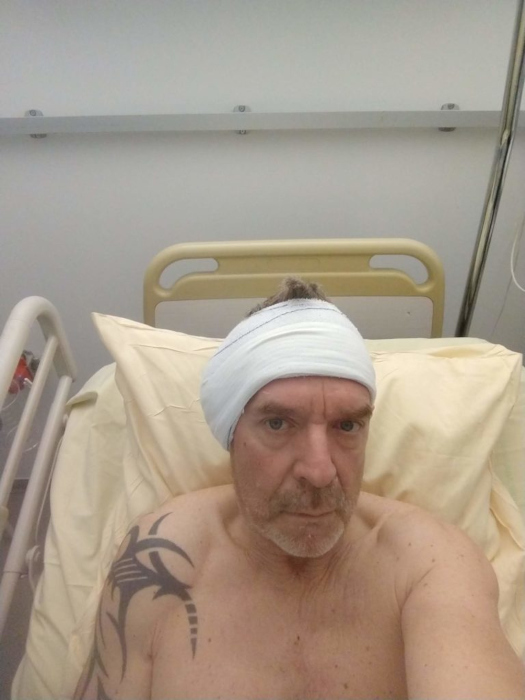
The operation takes between two and three hours, though I never learnt how long it actually took. I awoke in the salle de réveil / recovery room. Not having my watch, I had no idea of the time. Extremely groggy, they kept me there for several more hours. They finally wheeled me to my room around 7 pm.
My head really hurt, one long, bad headache which would last for days, but I was hungry. An hour later, they brought me my dinner. I was able to eat, oh yes !!!
After dinner, I even managed to walk around the ward a little, though I was suffering from dizziness.
19/02/2019
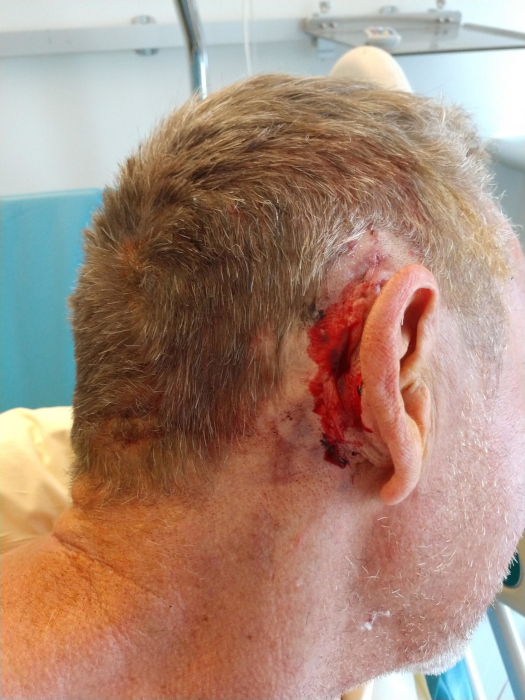
I ate breakfast, though I still had a nice banging headache (this basically lasted for about two weeks). After breakfast, they took off the bandage. What a relief. I then had a scanner (no IRM/MRI as now fitted with a Cochlear, you cannot have one) to see if all was correct inside my head. All was good with the scanner, and around 11 am was able to leave the hospital. Direction home by taxi.
I arrived home to see my wife and sit down for a meal. This actually didn’t go down well. I was more and more dizzy. At the same time, the stomach was playing up. The after effects of the anaesthesia and the dizziness after being operated on the ear as they remove the inner ear.
For the next two weeks, I basically went from headache to headache. Your head not only hurts, but it’s all stuffed up. It’s like when you get a really bad hangover, except it lasts for weeks. I only took paracetamols I don’t like taking the stronger stuff. The stomach also played up for well over a week. The dizziness was quite often.
26/02/2019
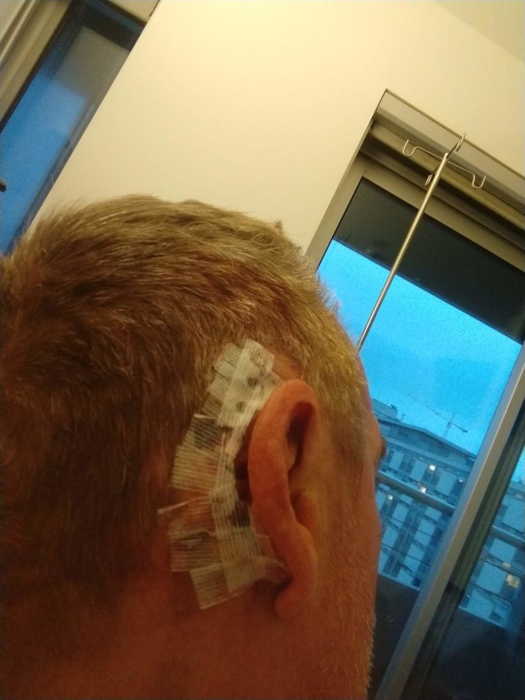
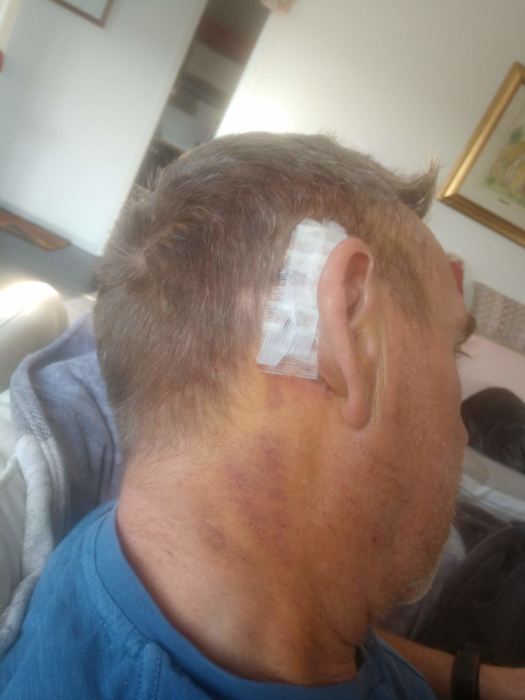
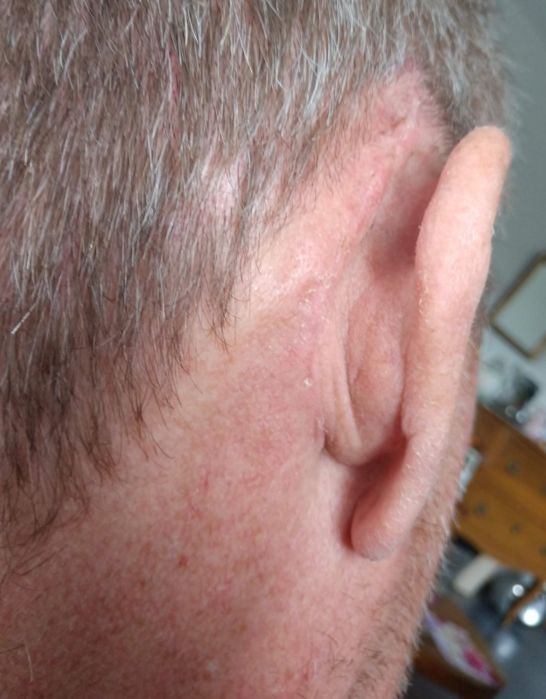
A control visit at the hospital, to take off the plasters that were covering the wound. All was extremely clean, as shown in the photos below. I was starting to feel more normal. Although stomach and dizziness were still playing up. For info, no sports allowed.
12/03/2019
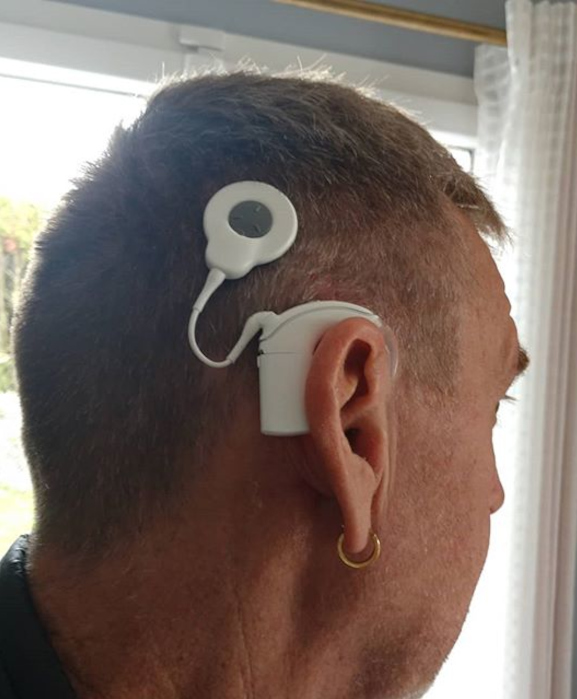
Big day today. It's fit and switch on the implant time. A two-hour meeting at the hospital to fit and switch on the implant (me being me, I chose a discreet coloured implant, WHITE….).
The appointment was at 4 pm and set for two hours. I didn’t know what to expect, although having read up a little. I knew that basically today’s meeting was to switch it on. Do a sort of special audiogram test via the implant and adjust the implant’s settings.
The settings are a bit like an audiogram. You tell the Dr when you can first hear the beep and again when the beep is comfortable without being too loud. This, for me, was 22 times as the model I have has 22 contacts in my head.
After the settings were finished, now came the moment to see what would happen. She switched on the implant.
Let’s switch it on
I’d read many reports from different people about this. Many said that they could hear noises but couldn’t make out or understand voices. Well, I was lucky; this may be because I had only lost my hearing five months ago. Straight away I could understand the Dr when she spoke to me.
Now, don't get me wrong. Her voice wasn’t normal. It was like a child who had just breathed some helium gas, very childish, very tinny. But I was able understand most of what she said, though I had to concentrate. My wife started crying as I could understand some spoken words, remember I have just spent the last five months not understanding anything or rather very very little.
The appointment was finished for the day, having taken just over two hours. The Dr said that the sounds should change and become more normal as my ear, or rather as my brain, got used to the implant.
25/03/2019
I’m still not really able to sleep on the right side, as it’s still quite tender. The Nucleus 7 (the Cochlear model) rubs against the skin. I find the Nucleus 7 a very bad design. Its design is rather ‘square’ behind the ear and not at all comfortable. Nowhere near as good as the ReSound Enso 3D that I wear in the left ear. Although both are made by the same mother company, The Nucleus 7 could learn from the ReSound's contoured design.
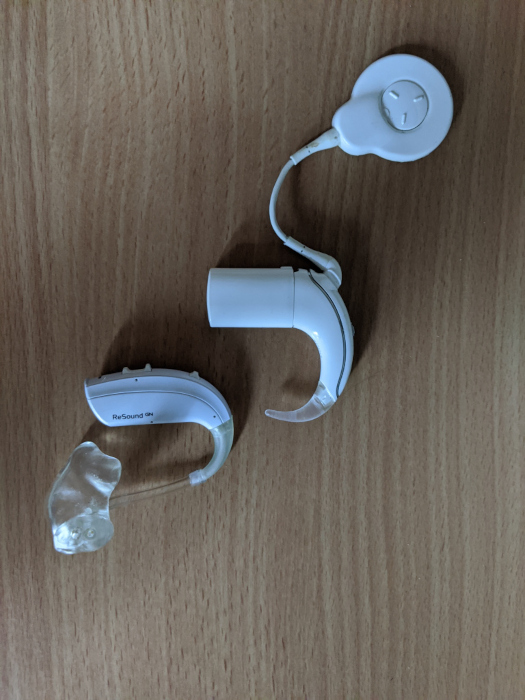
ReSound Enso 3. Hearing aid, left ear
Cochlear Nucleus – Here
28/03/2019
I saw my Osteopath today. My skull, jaw and cervicals (bones in the neck) were all out of place. That’s probably due to the way you are manipulated on the operating table. Once these were nicely put back in place, I noticed my dizzy spells were a little less frequent. However, they had not disappeared completely.
29/03/2019
For the moment. I can hear and understand some of what is said to me, but only in a one-to-one situation (which will never really change). At dinner parties, restaurants or at the gym, it’s very complicated, to be honest, almost impossible. TV, Radio, and Telephones are still a no-no.
The ear, even after a month since the operation, is still tender. I still have slight dizzy spells, basically when I turn my head.
Basically, listening and talking to people is only possible on a one-to-one basis. As soon as there are more than a few people, I can’t understand what they are saying, and more than a meter or so away, it’s impossible. Also, you really need the person to look at you while talking; just being able just seeing their lips helps a great deal with the comprehension.
TV or Music
Television is still impossible, music as well. Impossible to understand the instruments and voices. I can listen to David Bowie or U2 but not know who or what is playing. It is just noise.
I can stream the TV directly into the implant, bypassing the outside microphones, using a special box connected by Bluetooth to the implant. It’s better. But it’s still extremely difficult to understand most of what is said, and to be honest, I need the subtitles on even when streaming. Also, if my wife talks to me, I have to turn it off. Both talking at the same time is impossible.
I can communicate with the person in front of me. When there are many, then it’s difficult, almost impossible; if two or more people talk to you at the same time, then that is a big no-no. A lot of background noise, like in a restaurant, is almost impossible and extremely tiring. When I get home, for instance, after a dinner party, I just want to take the implant off and have some calm.
Sport at last
I’ve slowly started working out at the gym again, as I had the green light to do some sport. Though very slowly, as I’ve not done any sport since breaking the ankle or rather the Malleolus.
I actually jumped on my bike again, though this was silly of me, as I was still having dizzy spells, but as long as I didn’t stop or turn my head, I was OK.
Update: The dizzy spells will stop as your body gets used to not have a inner ear, though it takes a long time.
I’ve started most of my sports, biking, swimming, gym and CrossFit. I don’t wear the implant for any of these.
- At the Gym or CrossFit, there is just too much ambient noise, and with or without it, I cannot understand anyone.
- On the bike, it’s impossible as the microphones capture the wind, even if it’s not a windy day, it's like having a windy storm right in your ear, extremely unpleasant and almost impossible to wear a helmet. Even if a rider is next to you, you can’t understand them anyway.
- Trekking, I can wear it.
- Running, I can wear it. But often don't.
April 2019
I am now waiting for the first follow-up adjustments. Hopefully, we’ll be able to get the voices to sound a little more human.
The right side of my head still hurts a little. It really takes time to heal and start feeling normal again.
30 April 2019
I’ve now had two appointments for adjustments. The robotic/ tinniness/helium children’s voices are basically the same, making it a pain to listen to people at the end of the day. It’s very tiring. The meetings for the adjustments take about an hour, the Dr has quite a lot of work or rather adjustments to make.
15 May 2019
I had now about three or four settings updates at the hospital, they don’t really change much, basically they just test the minimum level that you can hear and the maximum level that is comfortable for you. Again, these meetings take about an hour every time.
I seem to be lucky in the fact that I understood straight away from receiving the implant, whereas certain personnel apparently take months or even longer. Even now, though, voices are still not natural.
5 Juin 2019
I made a real telephone call today to a bike shop in England to order a new bike. Streaming directly into the implant, like the TV streamer. Though once again it was extremely hard to understand the other person.
Firstly, I tried with just the implant, which was, as I expected, rather difficult, basically because of the lack of ‘bandwidth’ with the implant; there is not enough bass, and as always, too tinny. Then I added my left ear ReSound hearing aid (as they can work together and I can stream to both of them),
Now this was better, as I get more ‘volume’, more ‘bandwidth’, making the telephone call far easier to understand. It’s not perfect, but I was able to talk and understand most of what was said.
Though I needed to get the guy to repeat himself often and had to ask him to talk slowly. I got it done. It was difficult, you can’t really ring someone and just have a chat.
January 2020
Basically, nothing has changed since June of last year. Conversations on a one-to-one basis are normally OK, but as always, with more people, a dinner party, or at a restaurant, it’s still complicated. I can rarely understand a waiter in a restaurant.
I need people to look at me while talking to me so that I can capture as much as possible. You will be surprised by the difference between someone looking away or looking at you while talking to you.
Also, the quality of hearing depends on where you are; for instance, I hear far better when outside (unless there’s wind or rain), as outside, there is no reverberation. In certain rooms, the kitchen at home is a pain. A room with a lot of soft furnishings is better; a small room is often the worst, as the sound bounces off the walls. When I’m seeing my Ostéopathe, for instance, this is in a very small room with a low ceiling. I can hardly understand her at all.
Electrodes
On a Cochlear implant, they have 22 electrodes that basically 'tickle' your nerve with electricity. With Cochlear, only 8 are switched on.
I have had the settings on my Implant changed and now have 11 working rather than 8 as standard. Why? because for me it's like an equaliser. The more channels you can have, the better the sound quality.
So I’ve got 11 electrodes switched on, which seems to be slightly better than 8. The problem is that the more electrodes you have, the quicker the battery dies, as they eat juice (you are ‘tickling’ your audio nerve with more electricity), also the doctor can’t do much more, and the brain coping has problems when more are switched on. 8 is the standard, apparently.
So what’s next?
The doctors want to implant my left ear, as it doesn’t understand words anymore. I'm down to under 10% comprehension in an almost perfect hearing situation. It's the nerve, it's totally shot, it’s useless, but I will not do it. Why?
For a couple of reasons. Firstly, it lets me hear sounds that I don’t have unless I'm wearing the implant. Also, having two implants means that you are TOTALLY deaf when not wearing them, in bed, for instance. For the moment, even without the implant on, I do hear some sounds with my left ear.
If and when the left ear finally gives up on me, then I’ll get the second implant, but not until that happens. Here are some more reasons.
A couple of weeks ago, there was a storm where I live. I was in bed but heard a strange noise. I got up, I checked outside, and some roof tiles had come loose and slid down the roof. Having two implants and not wearing them, I wouldn’t have heard anything. You can’t wear your implants to bed when sleeping. Also, I have a smoke alarm in my bedroom. I can hear that, with two implants not being worn, I wouldn't.
Also, I often drive without my implant (for long distances), and the microphone picks up all sorts of mechanical noises, which are a pain. So I can hear if someone sounds their horn, for instance, and I’m still aware of things around me without the implant.
In March 2020, I’ll arrive at the one-year stage. The monthly meetings will now be every three months as the settings are now finished. Then, after that, it will be only an annual checkup.
2026
So about seven years on, the situation hasn't changed. I'm now down to an appointment about every eighteen months. I have the brand new upgraded Nucleus 8 model, but it hasn't changed anything. Dizziness is no longer an issue. I worked and still work on my equilibrium, as I need that when doing my CrossFit workouts, restaurants, dinners are still a pain, and I still need to get home and take off the implant to give me some calm.
The left hearing aid hasn't died on me. I no longer wear the Re-Sound hearing aid, as to be honest, it doesn't really help.
A Cochlear Implant is better than being deaf. That’s a certainty.
There is some really clever tech here. You are, or you can be pretty independent with it, I am anyway. The quality of the sound is far from natural.
Remember, the bandwidth is extremely small (Cochlear implants typically process an acoustic bandwidth of 250–8,000), but it does get better with time.
My wife's voice is as I remember it; people's voices I can distinguish between so and so. So, although I might seem to be negative above, I’m quite happy with it.
Some photos